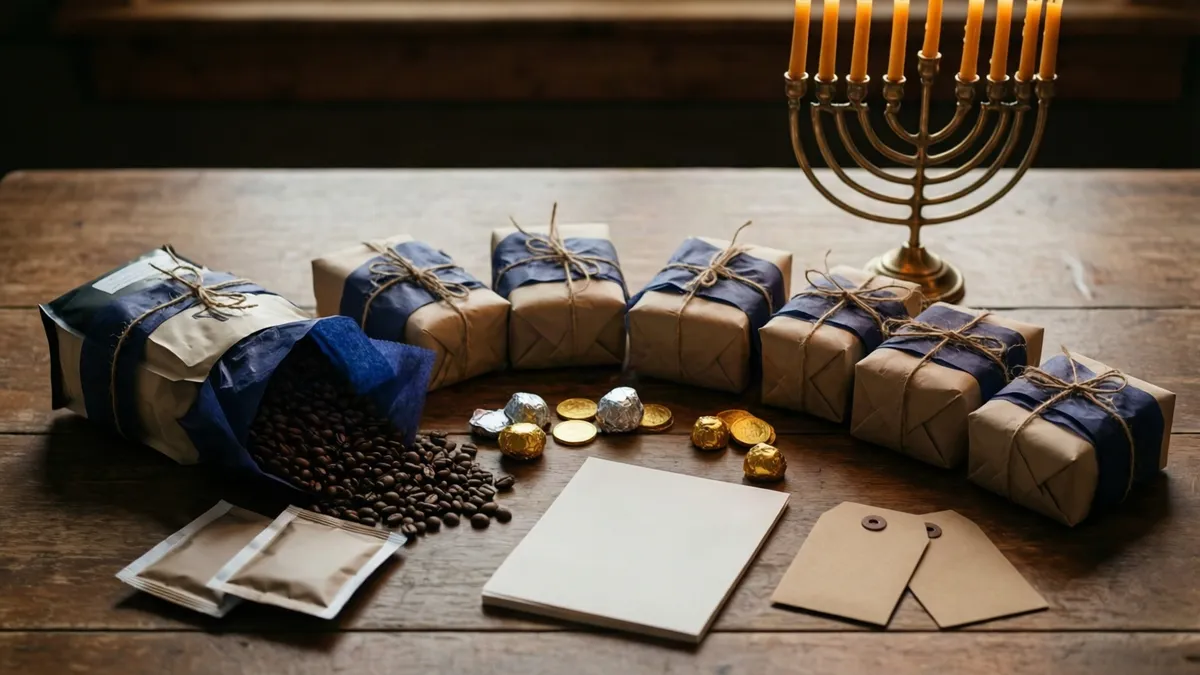
In short: The best Hanukkah coffee gift is rarely one grand object. It is eight small, consumable nights, with the Jewish specificity carried by the roaster, the certification, or the card you write. Shop Israeli and Jewish-owned roasters first, confirm kosher or pareve status on the listing, and split boxed sets before wrapping. Anything that cannot be divided, used up, or paired with a card fails the eight-night test.
We write buying guides, not reviews: we have not brewed with anything on this page. Certification details and shipping terms come from the listings as written, and whatever Amazon shows when you click is the authoritative figure.
This article contains affiliate links. If you buy through one, we earn a small commission at no extra cost to you. We only recommend what we would suggest to a friend.
The Federal Trade Commission's endorsement guides, 16 CFR Part 255, require a disclosure like that one to be difficult to miss, so it sits above every link here. Our full affiliate disclosure has the rest.
Hanukkah runs eight nights, and that is a format, not a constraint. One object has to carry a whole holiday. Eight nights let one bag of beans become three of them.
Coffee anchors the series safely. The National Coffee Association's 2026 National Coffee Data Trends report found 66% of American adults had a coffee the previous day, more than any other beverage including bottled water. Our gifts for coffee lovers guide starts with the machine on their counter; this one starts with the calendar.
What we measured: We read all 13 ranking pages this search returns. Eight of the 13 declare a count in the headline. Yet almost none name a single Hanukkah-specific item. Prices run roughly $20 to $3,299, with a median near $320. This list was built to fill that gap. It can miss: some pages never rendered their products, and the prices are as the guides quoted them, not live listings.
Eight Nights, Not One Grand Gesture: How This List Works
How many gifts does each night take? One per night is a family custom, not a rule. Plenty of households give once and light the rest. We build for the nightly version, because nightly is where consumables win: a bag divides, while a basket that cannot be split is a one-night gift in eight-night packaging.
The eighteen, ordered by how cleanly they divide:
- Half-pound bags from an Israeli roaster. Two roasts, one night each (browse Israeli coffee).
- A capped subscription from a Jewish-owned roaster. Set the delivery count yourself; our subscription guide explains who picks the beans.
- Kosher-certified single origin. The listing should name the certifier, not just print "kosher" (kosher coffee beans).
- Eight single-serve pour-over bags, one per night (single serve pour over packets).
- Specialty instant. The beginner-safe night; gear gathers dust, instant gets drunk (specialty instant coffee).
- A decaf from the same roaster, for the late nights.
- Cold brew bags, steeped overnight.
- A roaster gift card, folded into night one with one small bag.
- Beans taped to a box of gelt. Two traditions, one night.
- Candied espresso beans, pareve marking checked first (chocolate covered espresso beans).
- A Hanukkah tumbler from a Jewish museum shop. Vetted seller, no slogan.
- A burr grinder (two shaped plates, not spinning blades), only if they already grind.
- A 0.1 g scale, for the person who weighs.
- A gooseneck kettle (the narrow curved spout), for a pour-over owner.
- An airtight canister protecting nights one through seven.
- A ready-made basket, minus the filler (Hanukkah coffee gift basket), split before wrapping.
- Drip bags for the commute. Per the same 2026 report, 36% of past-day specialty drinkers had their coffee away from home, against 23% of traditional drinkers. Drip bags live in a coat pocket.
- The card. A written blessing costs nothing and outlasts the beans.
Bean and Roaster Gifts for Jewish Coffee Lovers
Beans carry the thesis best, and the specialty shelf is now the mainstream one. The 2026 report found 47% of American adults had specialty coffee the previous day, ahead of traditional coffee at 42%.
| Gift | Jewish or Israeli connection | Kosher or pareve, per the listing | Price band (ours) | Order-by date | Splits across eight nights? | Coworker-safe? | Ritual or consumable? |
|---|---|---|---|---|---|---|---|
| Israeli roaster bean trio | Roasted in Israel | Often certified; check for a named certifier | $30 to $60 | Varies; confirm on site | Yes, 3+ nights | Yes | Consumable |
| Jewish-owned roaster subscription | Ownership and story | Stated per roaster | $40 to $100 | Subscribe early | Yes, weekly | Yes | Consumable |
| Kosher-certified single origin | Certification carries it | Named certifier required | $18 to $30 | Varies | Yes | Yes | Consumable |
| Hanukkah boxed basket | Holiday packaging | Only if contents say so | $40 to $90 | Tight; order first | Only if split | Yes, boss included | Consumable |
| Museum-shop tumbler | Judaica curation | N/A, not food | $20 to $35 | Varies | No, one night | Borderline | Ritual-adjacent |
Price bands are our editorial judgment, not quoted prices, and order-by cutoffs were not posted consistently at writing.
Our take: Our call is consumables over objects, eight ways: beans, drip bags, and a written blessing beat any single machine on most counters. The exception is a recipient who already grinds and weighs, where one good gear night, the burr grinder above all, beats a third bag. Slogan mugs fail both tests: they cannot be divided, and nobody asked for one.
Beyond the Mug: Hanukkah Coffee Gifts for Coworkers
Coworkers and bosses change the math. The 2026 report states 69% of 25–39-year-olds had specialty coffee in the past week, the highest share of any age group. If your office sits in that band, a small specialty bag is a safe desk gift: consumable, mid-band, slogan-free. A ritual object belongs to whoever asked for one. Where the budget bends upward, we keep luxury coffee gifts in a separate guide.
On mugs: a mug is night one, not the holiday. Judaica drinkware from a vetted Jewish retailer can hold that night; a pun cannot. Baskets are the other trap, which is why item sixteen says split or skip.
Kosher, Pareve, and What to Write on the Card
Kashrut describes food, not ceramics. Pareve means a food contains neither meat nor dairy, which matters in a kosher kitchen. Coffee itself is water and roasted beans. Certification questions live in flavored blends, candied beans, and basket extras. Read the listing for the certifier's name.
Observance ranges widely across North American Jewish communities, as Springer's American Jewish Year Book 2024 documents community by community. Ask where your recipient sits before gifting anything ritual. Then borrow our card wording: "Chag sameach. Eight nights, eight cups. Night one is [roast name]; the rest are yours to open. May every cup be worth the wait."
When should I order coffee beans for Hanukkah delivery?
Order at least a week before the first candle. Roasters post holiday cutoffs on their own shipping pages, and they vary. For freshness, look for a roasted on date within the past month rather than a "best by" stamp.
What if they don't grind their own beans?
Then whole beans are a problem, not a gift. Ask one question about their counter, or default to ground coffee from the roaster and the drip bags on this list. Gear without a grinder answers nothing.
Is a gift card too impersonal for Hanukkah?
Impersonal beats wrong. When you do not know their taste, their gear, or their certification needs, a roaster card is the answer that cannot miss. Pair it with one small bag so night one starts physical.
Do Hanukkah gifts have to be Jewish-themed at all?
No. A sincere friend arriving with an excellent bag of beans carries both halves by itself. The theme earns its place when it comes from the roaster or the certification, not a printed pun.
Tomas Vega writes buying guides, not reviews; nothing on this page was brewed, tasted, or tested by us.
Sources
- Specialty Coffee Association — "New Release: 2026 National Coffee Data Trends Specialty Coffee Report" (https://sca.coffee/sca-news/2026-national-coffee-data-trends-report) "Retrieved 2026-09-11".
- Springer — "American Jewish Year Book 2024: The Annual Record of the North American Jewish Communities Since 1899" (https://link.springer.com/book/9783032157492) "Retrieved 2026-09-11".
- Federal Trade Commission — "Guides Concerning the Use of Endorsements and Testimonials in Advertising" (https://www.ftc.gov/legal-library/browse/federal-register-notices/guides-concerning-use-endorsements-testimonials-advertising) "Retrieved 2026-09-11".