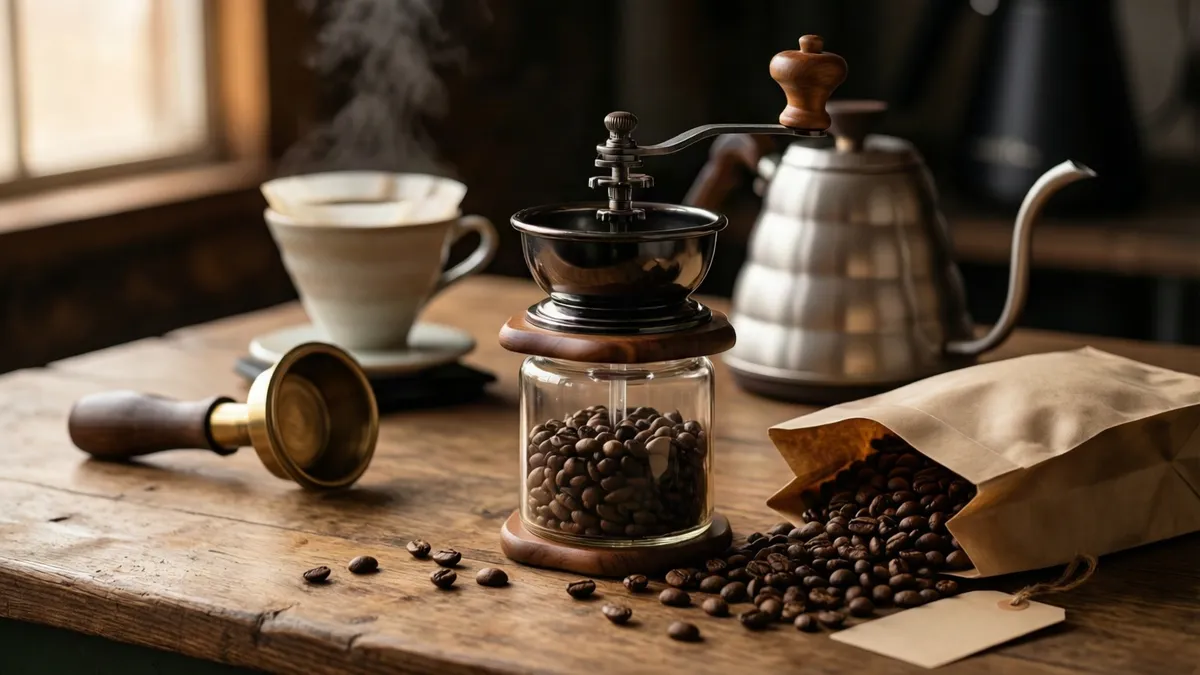
In short: The best coffee gift is the one that matches how the recipient actually brews, not how much they love coffee. Ask whether they grind their own beans — that answer separates the gifts that get used from the gifts that get regifted. This guide organizes every pick by that question, so you can buy with confidence even if you have never brewed a cup yourself.
We write buying guides, not cupping reports: we have not brewed with every product on this page. Brewing figures are quoted from the Specialty Coffee Association or the manufacturer, and prices, availability and ratings change constantly — whatever Amazon shows when you click is the authoritative figure.
This article contains affiliate links. If you buy through one, we earn a small commission at no extra cost to you. We only recommend what we would suggest to a friend.
The Federal Trade Commission's endorsement guides, 16 CFR Part 255, require a disclosure like that one to be difficult to miss, so it sits above every link here. Our full affiliate disclosure has the rest.
According to the National Coffee Association's 2026 survey, coffee is the most-consumed beverage in the country, with 66% of Americans having had a coffee in the past day. The National Coffee Association's 2026 survey found that 66% of Americans had a coffee in the past day, more than any other beverage including tap or bottled water. Most people on your gift list likely drink it.
But "drinks coffee" is not a gift category. Someone who pulls espresso shots at 6 a.m. and someone who grabs a latte on the way to work share a beverage and almost nothing else. Our pillar guide, Gifts for Coffee Lovers, From Someone Who Doesn't Drink It, starts from the machine on the counter. This page goes one level deeper: it starts from the grinder.
The one question that decides every coffee gift
Do they grind their own beans?
That question is the lens for every recommendation on this page. Not budget. Not brand. Not how much they love coffee. Whether they grind tells you what they already own, what they already know, and what they will actually use.
A burr grinder crushes beans between two shaped plates, producing evenly sized particles. A blade grinder chops, producing uneven dust and chunks in the same scoop. The difference is not subtle. The Specialty Coffee Association's published standards treat grind consistency as a foundational variable, on par with water temperature and brew ratio.
If they grind, they have crossed the threshold where equipment upgrades pay off. If they do not, a grinder is the single highest-impact gift you can give them. The rest of this guide branches from that fork.
Here is our suggested decision checklist — copy it, fill it in, and the gift nearly picks itself:
- Find out what machine is on their counter. A photo works if you cannot visit.
- Check whether they own a grinder, and whether it is a burr or blade model.
- If they use pods, identify which system. Pod machines take one cartridge type only.
- If they only drink coffee outside the home, skip equipment entirely.
- Match your budget to the category that fits, using the table below.
- When in doubt, buy what runs out: beans, filters, or a roaster gift card.
The NCA's 2026 data reinforces why this matters: 47% of American adults had specialty coffee in the past day, surpassing traditional coffee at 42%, per the the same study. Specialty coffee is now the mainstream, and specialty coffee demands fresh grinding.
They grind their own beans: upgrade the grinder
Someone who already grinds has made a commitment to the craft. Your gift should reward that, not duplicate it.
If they own a blade grinder, the upgrade is obvious. A burr grinder — manual or electric — is the single biggest flavor improvement they can make, and the SCA's standards place grind uniformity at the center of repeatable brewing. A manual burr grinder is affordable, quiet, and travel-friendly. An electric one trades price for speed and consistency at higher volumes.
If they already own a decent burr grinder, look sideways instead of up. A precision scale with a built-in timer lets them repeat a good brew instead of guessing at it. A gooseneck kettle — a kettle with a narrow, curved spout — gives pour-over brewers control over flow rate that a standard spout cannot match. Per the manufacturer's spec page, temperature-control models hold water at a set point; that feature matters more than capacity.
For the grinder owner who has everything, bean storage canisters that vacuum-seal or displace air extend the window between roast and staleness. The FDA does not require a roast date on coffee packaging, so a roaster that prints one is volunteering information a "best by" stamp never carries. A canister protects what that date tells them.
Espresso-specific accessories make sense only if they pull shots at home. A tamper, a distribution tool, or a puck screen are small, specific, and welcome — but only to someone who already owns an espresso machine. Buying them for a drip brewer is buying paperweights.
They buy pre-ground: the grinder is the gift
This is where the biggest gift impact lives.
Pre-ground coffee loses aroma compounds faster than whole beans, because grinding increases surface area exposed to air. The USDA's Foreign Agricultural Service coffee data tracks global production and trade flows, but the freshness principle is simpler: once ground, coffee has a short shelf. A grinder reverses that.
A burr grinder is the gift that keeps giving here. Every bag of whole beans they buy afterward will taste noticeably different from the pre-ground cans they have been using. The SCA's brewing standards explain why: consistent particle size means even extraction, which means the cup tastes the way the roaster intended.
Manual burr grinders fit under $50 and suit someone who brews one or two cups at a time. Electric models start higher but save effort for daily drinkers. Either way, pair the gift with a bag of whole beans from a roaster that prints a roast date, so they can use it the day they open it.
If a grinder is beyond your budget, a pour-over dripper and a pack of paper filters is a gentler entry point. Cone-shaped drippers, flat-bottom drippers, and hourglass-shaped carafe brewers all make filter coffee with hot water and gravity. No machine, no pods, no electricity. They work with pre-ground coffee, but they work better with freshly ground, which loops back to the grinder.
A French press is a forgiving manual brewer that requires coarse grounds, hot water, a short steep time, and a plunge. It tolerates inconsistent grind size better than pour-over, which makes it a good companion for a blade grinder until the burr upgrade arrives. A compact immersion brewer that uses air pressure to push coffee through a paper filter is another forgiving option for beginners, travelers, and dorm rooms. Per the listing, it brews quickly and packs into a cup.
They use a pod machine: work within the system
A pod or capsule machine takes sealed single-serve cartridges made for one system only. You cannot mix brands. The gift has to live inside that walled garden.
A reusable pod lets them fill their own ground coffee into a compatible cartridge, which cuts waste and cost per cup. The trade-off is effort: they have to grind, fill, and clean it each time. If they chose a pod machine for convenience, that trade-off may not land well.
A milk frother or a stainless-steel milk pitcher pairs with pod coffee the way it pairs with any brew method: it adds texture without adding equipment. Someone who drinks lattes from a pod machine will use a frother daily. Someone who drinks black coffee from one will not.
Cold brew makers and pitchers suit a pod user who also likes iced coffee. This is because cold brew is a separate process that does not compete with the pod machine for counter space. Per the manufacturer's typical listing, cold brew involves steeping coarse grounds in cold water for an extended period, then filtering. Low-effort, hard to ruin.
Do not buy them a new brewer. A pod machine owner chose convenience, and a pour-over set or French press sends the message that their choice was wrong. Work with the system they have.
They only drink coffee at cafés: skip the equipment
Some people love coffee but never brew it. Equipment is the wrong category for them.
A subscription to a local roaster works, because it delivers something they already value — good coffee — without requiring gear they do not own. A gift card to their regular café works, because it is money they will spend anyway, redirected into a gift.
Coffee-themed books — a world atlas of coffee, a guide to brewing methods — sit on a shelf and look good there. They are not equipment. They do not require a counter. The International Coffee Organization's specialized reports cover market data and production trends; a well-illustrated book covers the same territory for a general reader, and makes a better gift.
Experiential gifts — a barista class, a roastery tour, a cupping session — turn coffee enthusiasm into a memory. These are not products. They are tickets, and they work for the person who has every mug already.
For someone trying to cut back on caffeine, a bag of decaf from a quality roaster is a genuine gift, not a compromise. Decaf has improved, and a roaster that prints a roast date on a decaf bag is taking the coffee as seriously as the caffeinated version.
The price-tier cheat sheet: what each budget buys
Price bands below are ours, not a sourced figure. They reflect what we would spend in each category to get something the recipient will use.
| Price band | Grinder owner | Pre-ground buyer | Pod user | Café-only |
|---|---|---|---|---|
| Under $30 | Paper filters, a precision scale, or a bag of whole beans | A manual burr grinder (entry level) | A reusable pod or a milk frother | A café gift card |
| $30 to $100 | A gooseneck kettle or a bean storage canister | An electric burr grinder (entry) or a pour-over set | A premium capsule assortment | A roaster subscription (one to three months) |
| $100 to $150 | A higher-end burr grinder or an insulated tumbler set | A burr grinder upgrade plus a bean sampler | A milk frother and a cold brew maker | A barista class or roastery tour |
| Over $150 | An espresso accessory kit or a premium brewer | A burr grinder and a brewer bundled | Not recommended — pod users chose convenience | A multi-month roaster subscription |
Our take: If you know whether they grind, the table does most of the work for you. Our call is to spend on the grinder before the brewer, every time. A better grinder improves every cup they will make for years. A better brewer on top of a bad grind just makes bad coffee more precisely. The exception is the café-only drinker: buy them an experience or a consumable, never a machine.
Gifts that look like coffee but aren't: what to skip
Novelty mugs. Flavored tins. Pre-made gift baskets that are mostly shredded paper and cellophane.
These are the gifts that get regifted. The grinder question filters them out, because none of them improve the cup, and none of them match a brewing method. A mug with a coffee joke on it is a mug. A tin of flavored grounds is a product the recipient may not recognize as coffee.
Pre-made baskets are the worst offender. They look generous in the shrink-wrap and contain a random assortment of syrups, biscuits, and pre-ground coffee from a brand the recipient has never heard of. Cost per usable item is high. The coffee inside is usually stale.
Insulated travel mugs and reusable tumblers are the exception: they are practical, they get used, and they work for every recipient type. A good insulated tumbler keeps coffee hot on a commute, and a reusable cup cuts waste. Not coffee gifts in the brewing sense, but gifts a coffee drinker will use.
Eco-friendly gifts — reusable filters, reusable cups, suppliers with credible environmental certifications — land well when they replace something the recipient already buys. A reusable metal filter for a pour-over dripper replaces paper filters. A reusable pod replaces disposable capsules. These are gifts with a purpose, not gifts with a slogan.
The one gift that works for everyone: a roaster subscription
If you cannot answer the grinder question, buy a subscription.
A roaster subscription works for every recipient type because it is consumable, personal, and requires no new equipment. The grinder owner uses it with their existing setup. The pre-ground buyer can ask the roaster to grind for their method. The café-only drinker appreciates the beans as something to brew at a café that sells by the cup, or to pass along.
Most roaster subscriptions run for a set number of deliveries — one month, three months, six months — and you pay upfront. Decide how many deliveries you are paying for, put that number in the card, and read the cancellation terms before you order. A subscription is a recurring charge wearing a bow. The awkward conversation belongs to whoever's card is on file.
Look for a roaster that prints roast dates, ships within days of roasting, and lets you choose whole bean or pre-ground. Those three features tell you the roaster takes freshness seriously. The NCA's 2026 report found specialty coffee has overtaken traditional coffee in daily consumption, which means more roasters are competing on freshness — and the buyer benefits.
For international gifting, check whether the roaster ships to the recipient's country and how they handle customs. Coffee is a perishable agricultural product, and the USDA's coffee commodity data tracks the trade flows that determine shipping routes. A roaster that ships internationally will state it on their shipping page. If they do not, assume they cannot.
Which type of coffee gift is most likely to sit unused or be regifted?
Pre-made gift baskets and novelty mugs top that list, followed by brewing equipment bought for someone who never brews at home. Surplus espresso accessories bought ahead of a grinder upgrade are the second most common regift, because the recipient cannot use them until they also own the matching machine. The common thread is a gift that ignores how the recipient actually drinks coffee.
What is the best coffee gift for someone who is trying to quit caffeine?
A bag of whole-bean decaf from a roaster that prints a roast date, or a decaf subscription, is the strongest pick. Decaf from a specialty roaster is processed to retain flavor compounds. A roast date tells you the beans are fresh — the same standard you would apply to caffeinated coffee. Avoid decaf from a grocery aisle with no roast date, because it has likely been sitting for months.
Which coffee gift has the lowest cost per cup over two years?
A manual burr grinder paired with whole beans from a roaster, brewed in a French press or pour-over dripper. The grinder is a one-time purchase, the brewer is inexpensive, and whole beans cost less per cup than pods or café drinks. The math improves the more they brew, and a manual grinder has no motor or electronics to fail over that window.
How can I buy a coffee gift internationally without losing freshness or risk of breakage?
Find a roaster in the recipient's country that ships locally, so the beans arrive within days of roasting instead of weeks in transit. For equipment, check voltage compatibility on electric items — a 120V appliance will not work on 220V without a converter, and the manufacturer's spec page should list voltage. Glass brewers shipped internationally should come with breakage-replacement policies.
If the gift is a machine with a built-in grinder, do I still need to buy a separate grinder?
No. A built-in grinder handles the grinding step, though it is usually lower quality than a dedicated burr grinder at the same combined price point. The trade-off is convenience versus upgradeability: a separate grinder can be replaced or upgraded without replacing the brewer, and most built-in grinders cannot be swapped out independently.
What should I do if the coffee gift arrives damaged or the wrong model?
Contact the retailer within their return window — most major retailers provide a set period for unopened items, and damaged goods are typically returnable for a full refund including shipping. Keep the original packaging and take photos of the damage before contacting them, since the retailer may request proof. For perishable items like beans, check whether the roaster offers a freshness guarantee separate from the standard return policy.
Tomas Vega writes buying guides, not reviews; nothing here was tested by us.
Sources
- Specialty Coffee Association — "Standards" (https://sca.coffee/research/coffee-standards/) "Retrieved 2026-08-23".
- Specialty Coffee Association — "New Release: 2026 National Coffee Data Trends Specialty Coffee Report" (https://sca.coffee/sca-news/2026-national-coffee-data-trends-report) "Retrieved 2026-08-23".
- USDA Foreign Agricultural Service — "Coffee" (https://www.fas.usda.gov/data/commodities/coffee) "Retrieved 2026-08-23".
- International Coffee Organization — "Specialized Reports" (https://ico.org/specialized-reports/) "Retrieved 2026-08-23".
- Federal Trade Commission — "Guides Concerning the Use of Endorsements and Testimonials in Advertising" (https://www.ftc.gov/legal-library/browse/federal-register-notices/guides-concerning-use-endorsements-testimonials-advertising) "Retrieved 2026-08-23".