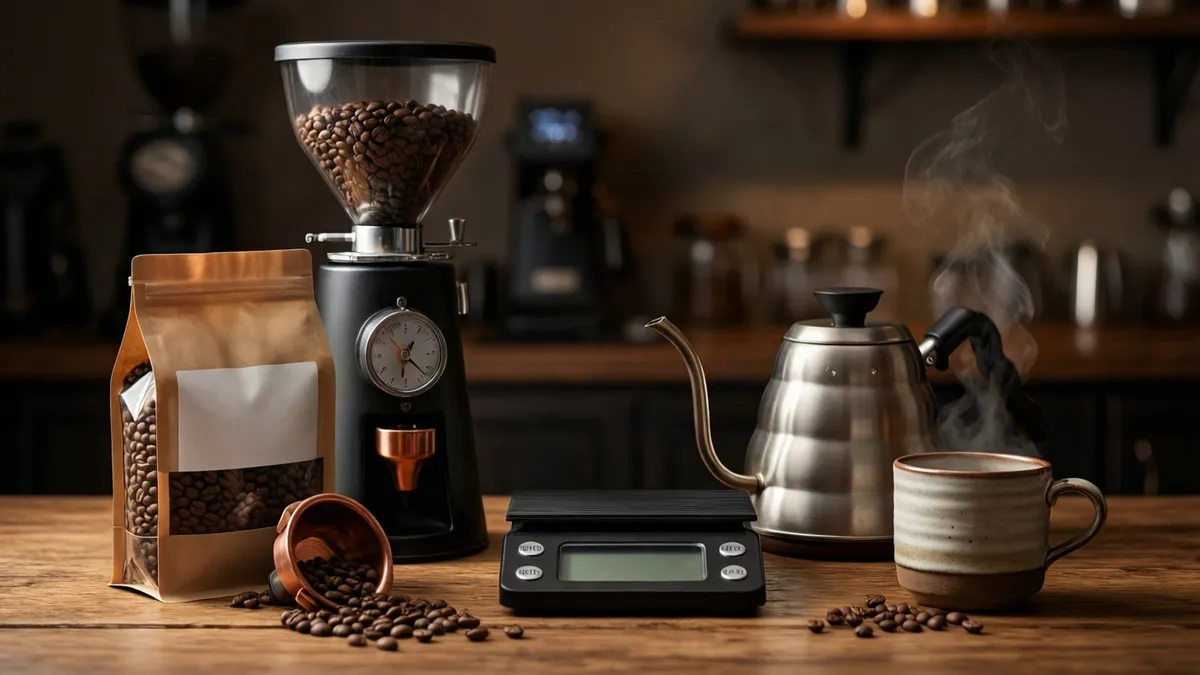
In short: The burr grinder is the one gift that changes a coffee lover's cup, even when they already own a machine. If they grind fresh already, buy beans, a subscription, or a precision scale instead. Skip the novelty mugs and decor — the counter is full, and the ritual is what matters.
We write buying guides, not cupping reports: we have not brewed with every product on this page. Specs are quoted from the manufacturer or the listing, and whatever Amazon shows when you click is the authoritative figure.
The Federal Trade Commission's endorsement guides, 16 CFR Part 255, require a disclosure like that one to be difficult to miss, so it sits above every link here. Our full affiliate disclosure has the rest.
Coffee is not a niche hobby you are buying into. The National Coffee Association's 2026 report found that 66% of Americans had a coffee in the past day, and 47% of adults had a specialty coffee. So the person you are shopping for almost certainly drinks it daily. The question is not whether they love coffee. It is what their setup is missing, which is the same question behind our pillar guide to gifts for coffee lovers.
The Grinder Is the Gift. The Machine Is the Photo.
Start with the mechanism, because it is the whole argument. A burr grinder crushes beans between two shaped plates to a uniform size. A blade grinder chops them with a spinning edge, which produces a mix of dust and boulders. Uniform grounds extract evenly; uneven grounds extract unevenly, and no brewer fixes that.
This is why the grinder beats the machine as a gift. A better brewer makes better coffee out of better grounds. A better grinder makes the coffee they already brew better, every single morning, with the machine still on the counter. If they own a blade grinder, this is the gift. Our burr versus blade guide covers the one spec to check from the listing.
If they already have a burr grinder, the table below is your map to an upgrade or a first buy. Price bands are ours, not a sourced figure.
| Grinder | Type | Grind settings | Price band | Best for (our judgment) |
|---|---|---|---|---|
| Entry electric burr | Electric, flat burrs | Around 40, per the manufacturer | $30 to $100 | Drip and French press drinkers |
| Hand grinder | Manual, conical burrs | Stepless or stepped, per the listing | Under $100 | Pour-over drinkers with limited counter space |
| Mid-tier electric burr | Electric, single-dose | 30 to 64 settings, per the manufacturer | $100 to $250 | Serious home pour-over and filter coffee |
| Espresso-capable burr | Electric, fine-range | Stepless micro-adjustment | Over $250 | Home espresso, where grind fineness decides everything |
Our take: Our call is simple. If they do not own a burr grinder, buy the grinder and nothing else — it outperforms any brewer upgrade at the same money. If they do own one, spend on what runs out or what measures: beans, a subscription, a scale. The only exception is the espresso person, whose grinder needs outgrow everything else first.
What to Buy If They Already Have a Burr Grinder
Then the answer shifts from gear to what gear consumes. Whole beans are the safe gift for someone whose equipment is covered, and they are the one item on this page guaranteed to disappear.
One check before you buy: the roast date. The FDA does not require a printed roast date, so a roaster that prints one is telling you something a "best by" stamp never does. Roasted-on dates let the recipient judge freshness themselves, which is exactly what a person with a good grinder cares about.
For the bag itself, roasters' own labels carry the tasting notes. The label might describe blueberry and cocoa; quote it, do not promise it. Single-origin bags and sampler packs work well here because variety is the point. When in doubt, a roaster gift card is a consumable that cannot be wrong.
Subscriptions: The Gift That Keeps On Charging You
A subscription solves the freshness problem permanently, which is why 11 of the 14 guides we compared recommend one. In our comparison of the top guides, multi-roaster services that rotate different roasters came up most often, because variety is the point when the recipient already owns everything.
Give it carefully, though. A subscription is a recurring charge wearing a bow. Decide how many deliveries you are paying for and put that number in the card. Read the cancellation terms before you order. The awkward conversation belongs to whoever's card is on file. A prepaid fixed-term plan beats an auto-renewing one for gifting, and the grinders they own will handle whatever arrives.
The Precision Tools That Turn a Machine Into a Craft
Small tools are the sweet spot for the person who has everything: they tighten control without demanding a new shelf. Three categories matter.
A scale with a built-in timer is the first one. The Specialty Coffee Association's published brewing control chart treats the coffee-to-water ratio as the core variable of strength, and a scale is the only way to hit a ratio twice. Dosing by eye is guessing.
Second, a gooseneck kettle — the narrow curved spout — gives pour-over brewers control over where the water lands and how fast. Third, the small espresso accessories: a tamper that matches their basket, a distribution tool for evening out grounds, a knockbox for the spent puck. A handheld milk frother rounds it out for anyone who steams milk at home. None of these needs counter space they do not already have.
Pour-Over and French Press: The Brewers They Probably Don't Have
Here is a quiet truth about coffee people with everything: they usually own one brew method, done well. A second method is a gift that fills a gap rather than duplicating a shelf.
A pour-over brewer — the cone or hourglass kind that drips into a vessel — is the classic hobbyist gift, and 11 of the 14 guides we compared cover it. It rewards a good grinder more than any other method, which is why it fits this article. A French press is the opposite temperament: forgiving, full-immersion, no paper filters. Models with fine-mesh or dual filters cut the sediment that plagues the classic design.
Add a Moka pot, the stovetop octagon that brews strong coffee over steam pressure, and you have covered the affordable classic. Any of these pairs naturally with the gooseneck kettle or the scale from the last section.
Espresso Machines: The Only Machine Worth Buying
If they do not own an espresso machine, that is the one big-ticket gift on this page. But the order matters: the grinder comes first, always. Espresso is unforgiving of uneven grounds in a way drip coffee is not. So, an espresso machine fed by a blade grinder makes worse coffee than the drip machine it replaced.
Two paths exist. A machine with a built-in burr grinder is the single-box answer — convenient, and the grinder inside is adequate. The separate-grinder path costs more and performs better, and it is the one we would pick for someone who already cares. Our luxury gifts guide covers where big money actually shows up in this hobby.
One honest note on cost: the machine is the entry fee, not the total. Beans, maintenance, and accessories follow. If the budget does not stretch to both machine and grinder, buy the grinder now and the machine later.
Cold Brew, Travel Mugs, and Smart Sippers: For the Away-From-Counter
Not every coffee happens at the counter. The NCA's 2026 report found that 36% of past-day specialty coffee drinkers had theirs prepared away from home, and 60% had cold coffee. If your recipient commutes or drinks it cold, this is their section.
A cold brew maker — the steep-and-strain kind — suits the slow, low-acid concentrate people make in batches. For the commuter, an insulated travel mug that actually holds heat beats anything decorative; look for a locking lid and a width that fits a car cup holder. And for the slow sipper at a desk, a temperature-control mug that keeps coffee at a set warmth is the one piece of "smart" gear that solves a real complaint. The NCA's same 2026 report had 76% of past-day specialty drinkers taking their coffee hot, so keeping it hot longer is a documented problem.
Coffee Books and Coffee-Laced Food: The Gifts That Don't Add Gear
Some gifts feed the interest without touching the counter. A well-regarded coffee reference book — the world-atlas kind that maps growing regions and processing — teaches the recipient why their favorite bag tastes the way it does. A practical brewing handbook does the same for technique. Neither needs a shelf they do not have.
Food works the same way. Coffee-infused chocolate, coffee sugar, syrups, shortbread: all consumable, all gone by spring. The same is true of the smaller supporting items worth remembering. These include a vacuum canister that slows staling, a reusable metal filter that replaces paper, and even a coffee-plant growing kit for the long-term project person.
What to skip: the mug, the candle, the sign that says the thing about coffee. The counter is full. The ritual is what they love, and clutter does not join a ritual.
The Decision, In Order
Here is our suggested checklist, in the order we would ask the questions:
- Do they own a burr grinder? If no, stop here — that is the gift, and nothing else comes close.
- Do they grind but own a blade grinder? Same answer. The burr upgrade changes the cup; nothing else on this page does.
- Is the grinder covered? Move to consumables: fresh-roasted beans with a printed roast date, or a fixed-term subscription with the delivery count in the card.
- Do they brew by hand? A scale with a timer or a gooseneck kettle tightens what they already do.
- Do they own only one brew method? A pour-over cone, a sediment-reducing French press, or a Moka pot fills a real gap.
- Do they drink away from the counter? Cold brew maker, insulated travel mug, or a temperature-control mug.
- Still unsure? Books and coffee-laced food. Nothing to return, nothing to shelve.
How long does a good burr grinder last before it needs service?
Manufacturers generally rate consumer burr sets in years of home use, and entry electric models commonly run several years before burrs need replacing. Treat it like a kitchen appliance, not a gadget: unplug it, brush out the grounds, and expect the motor to outlast the novelty.
Can you really taste the difference between blade and burr grounds?
You can taste the difference in the cup, and you can see it on the counter. Blade-chopped grounds are uneven, so some particles over-extract and others under-extract in the same cup. That is why we treat burr versus blade as the one spec you can confirm from a listing without knowing anything about coffee.
What is the most eco-friendly way to get rid of used grounds and paper filters?
Used grounds and unbleached paper filters can go into municipal compost where your city accepts them; check your local program's rules first. If you compost at home, let grounds cool and add them in thin layers. A reusable metal filter eliminates the paper stream entirely.
Does cold brew have less caffeine than hot coffee?
It depends on how it is brewed and diluted, not on temperature alone. Cold brew concentrate is often strong, then cut with water or milk, so the finished glass can land anywhere. We make no health claims either way — for us the cold brew maker earns its place on taste and batch convenience.
How do I fix channeling in espresso shots without buying anything?
Channeling is water racing through a crack in the grounds, and the fix is distribution, not equipment. Level the grounds in the basket before tamping, tamp flat, and keep the dose consistent by weighing it. A distribution tool helps, but a careful finger and a level tamp cost nothing.
Tomas Vega writes buying guides, not reviews; nothing here was tested by us.
Sources
- Specialty Coffee Association — "New Release: 2026 National Coffee Data Trends Specialty Coffee Report" (https://sca.coffee/sca-news/2026-national-coffee-data-trends-report) Retrieved 2026-09-17.
- Federal Trade Commission — "Guides Concerning the Use of Endorsements and Testimonials in Advertising" (https://www.ftc.gov/legal-library/browse/federal-register-notices/guides-concerning-use-endorsements-testimonials-advertising) Retrieved 2026-09-17.