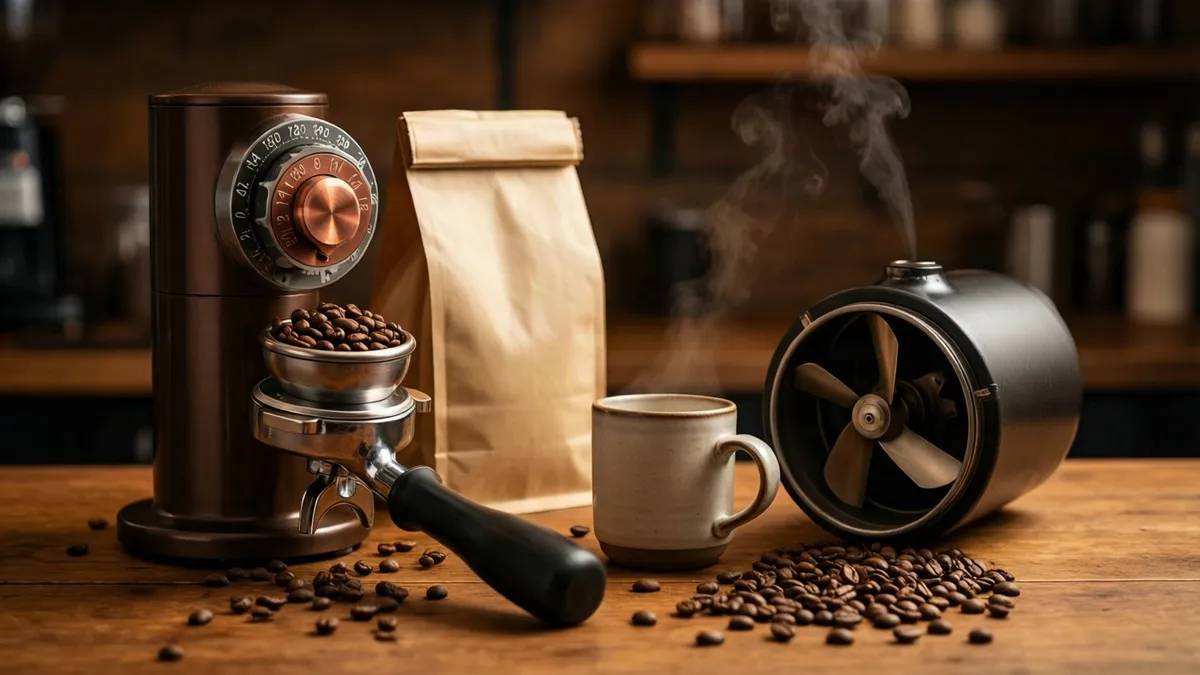
In short: A burr grinder is the right gift only if it has a grind-size selector. Check the listing for the number of grind settings — a blade grinder has none, a real burr grinder has at least a dozen. That one spec tells you whether the recipient can match the grind to their brewer, and it separates a daily-use gift from a counter ornament.
We write buying guides, not product reviews. We have not used every grinder on this page, and every spec here comes from the manufacturer's listing or the Specialty Coffee Association's published brewing standards. Whatever Amazon shows when you click is the authoritative figure.
This article contains affiliate links. If you buy through one, we earn a small commission at no extra cost to you. We only recommend what we would suggest to a friend.
The Federal Trade Commission's endorsement guides, 16 CFR Part 255, require a disclosure like that one to be difficult to miss, so it sits above every link here. Our full affiliate disclosure has the rest.
A grinder is the one piece of coffee gear the recipient uses every day and would not buy for themselves. That makes a burr grinder gift a strong choice, if you buy the right kind. Our gifts for coffee lovers guide starts by asking what machine sits on their counter, and coffee gifts that skip that question tend to miss. The grinder follows directly from the brewer, and the spec that separates a good gift from a wasted one is on the listing.
The one spec that makes a burr grinder a real gift
A burr grinder crushes beans between two shaped plates. A blade grinder chops them with a spinning propeller. The difference is not cosmetic. One produces particles of roughly the same size, and the other produces a mix of dust and gravel.
The spec that tells you which is which is the grind-setting count. A blade grinder has zero grind settings — one button, one speed, one result. A burr grinder has at least a dozen, and the listing will print the number.
If the listing does not mention a grind-setting count, it is a blade grinder. Or it is a burr grinder the manufacturer is embarrassed by. Either way, it is not the gift.
This is the one spec you can check from the listing without knowing anything about coffee. You do not need to taste the cup. You count the settings, and the count tells you whether the recipient can use it.
Why grind size matters more than the machine
Uniform particles extract evenly. Mixed particles do not. The fine dust over-extracts and turns bitter; the coarse chunks under-extract and stay sour. The Specialty Coffee Association's published brewing standards treat grind size as the variable that matches the coffee to the brewer.
A blade grinder cannot match grind to brewer because it has no grind adjustment. It chops until you stop it. Every brew method calls for a different particle size, and a blade grinder gives you the same one every time.
The grinder is the most important piece of home coffee gear for this reason. An expensive brewer paired with a blade grinder produces a worse cup than a cheap brewer paired with a burr grinder with settings. The grinder is the gift. The machine is the part that gets photographed.
A burr grinder with settings lets the recipient dial in. Espresso needs fine. Pour-over needs medium. French press needs coarse. The setting count is what makes that possible. A blade grinder's single speed makes it impossible.
How to check the spec from a listing
Open the product page. Search for "settings" or "steps." If the manufacturer is proud of the number, it is in the bullet points, the title, or the description.
If you see "pulse" or "chop" or "multi-purpose," keep reading. Those words describe a blade grinder. A blade grinder's listing will mention a stainless steel blade, a safety lid, and one-touch operation. None of those is a grind setting.
Here is a five-step listing check — our suggested version, copy it onto the product page and run it:
- Search the page for "grind settings" or "grind steps." A real burr grinder states the number.
- Look for "burr" in the title. If it says "burr" and lists a setting count, shortlist it.
- If the title says "blade" or "chopper," it is a blade grinder. Move on.
- Check the price against the bands below. A blade grinder at any price is still a blade grinder.
- If no grind-setting count appears anywhere on the page, assume blade. The absence of the spec is the spec.
Run the same check on burr coffee grinders on Amazon. The listings that print a setting count are the ones to shortlist.
Price tiers that make a burr grinder gift work
Price bands below are ours, not a sourced figure.
A blade grinder costs under $30. That is the entry point, and the main advantage — blade is cheaper, full stop. A decent burr grinder starts around $100. Enthusiast burr grinders run $200 to $500 and beyond.
The gift logic is simple. A $30 blade grinder is a $30 placeholder. A $100 burr grinder with settings is a $100 upgrade the recipient would not buy for themselves. That is what a gift is.
Durability matters. A cheap blade grinder can fail in two or three years, and there is usually nothing to repair. A repairable burr grinder — one where the manufacturer sells replacement burrs and parts — can last a decade. Check the manufacturer's parts page before you buy. If they sell burrs, they expect the grinder to stay.
A manual burr grinder is quieter, portable, and often cheaper than an electric one with similar burr quality. It is a good gift for someone who brews one or two cups at a time. An electric burr grinder is faster and better for someone who brews multiple cups before work.
Noise is a real factor. Some grinders are loud and high-pitched. Some are quieter and lower in tone. The listing rarely says which. If the recipient brews at 6 a.m. in a small apartment, manual burr grinders solve the noise problem entirely.
Match the grinder to the recipient's brewer
Ask what they brew. Espresso needs a very fine grind and a grinder with enough settings to dial in at that end of the range. Pour-over and drip need medium. French press and cold brew need coarse.
A burr grinder with 40 settings covers all of these. A burr grinder with 15 settings covers most. A blade grinder with one speed covers none of them properly.
If they use a pod or capsule machine, they do not need a grinder. Pod machines take sealed single-serve cartridges made for one system, and grinding beans does not enter the workflow. A grinder is the wrong gift for a pod user. Beans or a roaster gift card are the right one.
If they already have a blade grinder, a burr grinder is still worth giving. The spec that proves it will change their cup is the setting count. Their blade grinder has zero settings. The burr grinder you buy has a dozen or more. That difference is the difference between matching the grind to the brewer and not.
If they brew espresso, look for a grinder that goes fine enough and lists espresso in its range. Not every burr grinder does. A general-purpose burr grinder with 40 steps may reach espresso range, but a grinder built for espresso will hold that end of the adjustment more precisely.
Stepped adjustment clicks between fixed settings — beginner-friendly and repeatable. Stepless adjustment slides continuously, which matters for espresso dial-in but is overkill for pour-over. If the recipient is starting out, stepped is the safer gift. Stepless is for someone who already knows what they want.
What to skip: blade grinders as placeholder gifts
A blade grinder is not a gift for someone who brews daily. It is fine for cold brew, where the grind steeps for hours and particle uniformity matters less. For daily pour-over, drip, or espresso, a blade grinder is a step backward.
It chops. It cannot adjust. It produces a mix of particle sizes that extract unevenly. Giving one to someone who already brews is adding a second machine they will not use.
Skip the blade. Buy the cheapest burr grinder with a printed setting count. That is the gift that changes the cup.
Burr vs blade at a glance
| Blade grinder | Burr grinder | |
|---|---|---|
| Grind settings | None — one speed, one result | A dozen or more; listed on the spec page |
| Particle consistency | Uneven; chops into mixed sizes | Uniform; crushes between shaped plates |
| Price band (ours) | Under $30 | $100 and up for a real one |
| Best for | Occasional use, French press, cold brew | Daily brewing, pour-over, espresso |
| Gift verdict (ours) | Skip for daily brewers | Gift if settings match the brewer |
Our take: If they brew daily, a blade grinder is a placeholder, not a gift. Our call is the cheapest burr grinder with a printed grind-setting count that matches their brewer, and nothing that calls itself a grinder without one. The recipient who gets settings can match the grind to the brewer; the one who gets a blade cannot.
Is a blade grinder ever the right gift?
Yes, for someone who brews occasionally or makes cold brew only. Cold brew steeps grounds for twelve hours or more, so particle uniformity matters far less than it does in a three-minute pour-over. A blade grinder is also reasonable for a dorm room, a desk, or a travel kit where a burr grinder's footprint would not fit.
How many grind settings does a burr grinder need for pour-over?
Pour-over needs a medium grind, and any burr grinder with 15 or more settings will reach it. The advantage of 40 over 15 is fine-tuning — each step covers a narrower range, so the recipient can adjust by one notch instead of jumping. For pour-over alone, 15 is enough. For someone who also brews espresso, look for 40 or more.
Does a grinder warranty transfer to the recipient?
Most grinder warranties are tied to the receipt, not the owner's name. If you buy the grinder and gift it, keep the order confirmation — the recipient will need it to file a claim. Check the manufacturer's warranty page before you buy; terms vary by model, and some require registration within a set window after purchase.
What if they already own a blade grinder?
A burr grinder is still worth giving, and the setting count is the proof. Their blade grinder has zero settings, and every brew method they try is stuck at one particle size. A burr grinder with a dozen settings lets them match the grind to the brewer for the first time. That change shows up in the cup, even with the same beans and brewer.
Are manual burr grinders good gifts?
A manual burr grinder is portable, quiet, and often cheaper than an electric one with similar burr quality. It is a strong gift for someone who brews one or two cups at a time and does not mind hand-cranking. For someone who brews four cups before work, it is the wrong gift — the cranking adds minutes to a routine that does not have them.
Can a blade grinder work for French press?
It can produce a grind that works, because French press uses a metal mesh filter that catches most grounds regardless of size. But the cup will have more sludge at the bottom, and the uneven extraction will muddy the flavor. A burr grinder with a coarse setting is the better gift even for a French-press-only brewer.
Tomas Vega writes buying guides, not reviews; nothing here was tested by us.
Sources
- Federal Trade Commission — "16 CFR Part 255 — Guides Concerning the Use of Endorsements and Testimonials in Advertising" (https://www.ftc.gov/legal-library/browse/federal-register-notices/guides-concerning-use-endorsements-testimonials-advertising) Retrieved 2026-08-23.