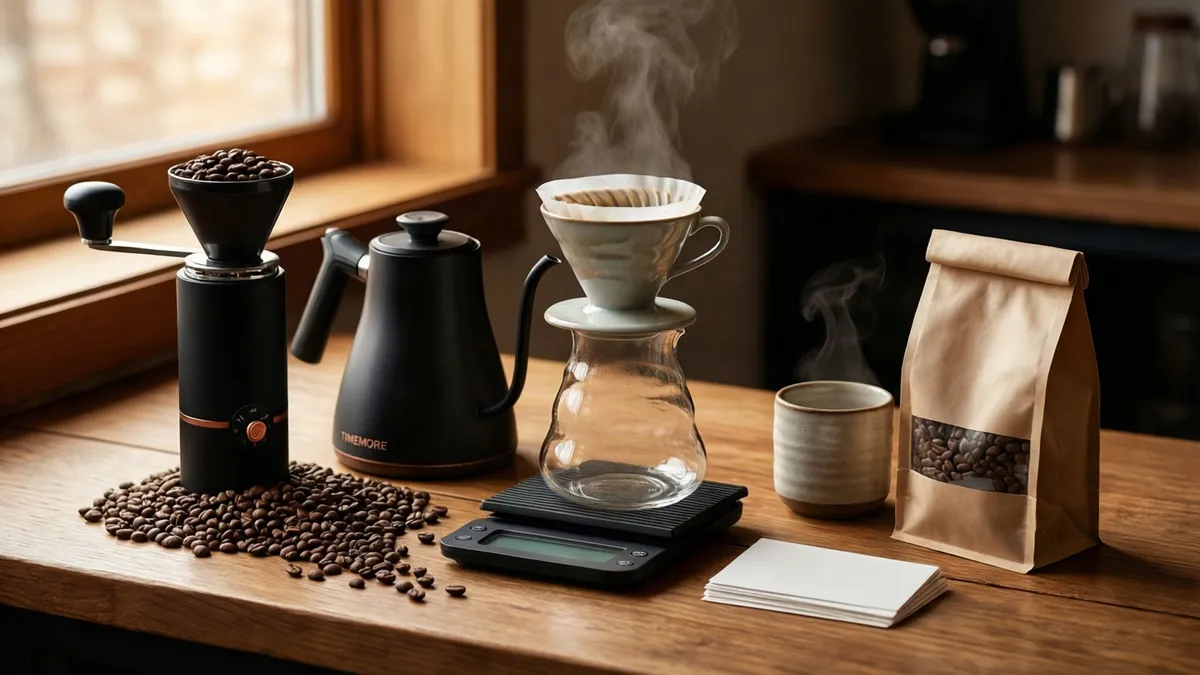
In short: The best gifts for coffee lovers match how they already brew, not what looks impressive in a box. Find out what machine sits on their counter, whether they grind their own beans, and whether they drink hot or cold. If you cannot answer those three questions, buy what runs out: beans, filters, or a roaster gift card.
We write buying guides, not cupping reports: we have not brewed with every product on this page. Brewing figures are quoted from the Specialty Coffee Association or the manufacturer, and prices, availability and ratings change constantly — whatever Amazon shows when you click is the authoritative figure.
This article contains affiliate links. If you buy through one, we earn a small commission at no extra cost to you. We only recommend what we would suggest to a friend.
The Federal Trade Commission's endorsement guides, 16 CFR Part 255, require a disclosure like that one to be difficult to miss, so it sits above every link here. Our full affiliate disclosure has the rest.
Coffee is nearly universal. The National Coffee Association's 2026 National Coffee Data Trends report found that 66% of Americans had a coffee in the past day. Additionally, 47% had specialty coffee in that same window. Your recipient probably drinks coffee, but that tells you nothing about how. Our pillar guide, Gifts for Coffee Lovers, From Someone Who Doesn't Drink It, starts from the same place: the machine on the counter is the whole question.
Where people drink it has shifted over the last century. The USDA Economic Research Service reported that sales at coffeehouses increased by 97% between 1998 and 2003. That shift turned coffee from a kitchen routine into something bought on the way to work. A gift that replaces a daily cafe purchase lands differently than one that decorates a shelf.
By Tomas Vega, written by the editorial team behind this site: gift researchers who compile buying guides from public sources, manufacturer specs, and customer reviews rather than hands-on product testing.
Gifts for coffee lovers need three answers first
Three facts settle almost every coffee gift decision. Get them before you spend.
-
What machine is on their counter? Espresso, drip, pour-over, French press, and pods are five separate gift categories. A pod machine takes one system only, and a pour-over dripper is useless to someone who brews espresso.
-
Do they grind their own beans? A burr grinder crushes beans between two shaped plates; a blade grinder chops. Whole beans are a gift for someone who grinds. If they do not, you have handed them a bag they cannot use well.
-
Hot or cold? The NCA's 2026 report found that 76% of past-day specialty coffee drinkers enjoyed their brew hot, while 60% say cold coffee remains a popular choice. Match the temperature, not your preference.
Our suggested fill-in checklist, copied into a text to whoever lives with them:
What machine is on the counter? Do they grind beans or buy pre-ground? Hot or iced? Any pods, and if so which system?
That is the whole interview. Everything below assumes you have at least one answer.
Coffee gifts for the pour-over brewer
Pour-over is a method, not a product. Hot water goes through ground coffee in a filter, by hand, in small batches. The brewer controls the pour speed and the water temperature. This is why a gooseneck kettle, with its narrow curved spout, and a gram scale both matter as much as the dripper itself.
The SCA's certified home equipment listing states that one approved drip maker heats water to 197°F–205°F in 3 seconds. That temperature range is the published standard for hot extraction. A gooseneck kettle lets a pour-over brewer hold something close to it by hand, which is the whole point of the method.
A pour-over coffee maker comes in cone, flat-bottom, and hourglass-carafe shapes. They are not interchangeable, but a recipient who brews pour-over will have a preference they can name. A gooseneck kettle is the gift that improves the pour without replacing the dripper. A coffee scale that reads to 0.1 g is the third piece, and the one most often missing from a setup that already has the other two.
The grinder is the gift, not the machine
If they own a blade grinder, a better grinder does more for the cup than a more expensive brewer will. Burr versus blade is the one spec you can confirm from the listing without knowing anything about coffee, and our burr vs blade grinder guide walks through it in detail. The short version: a burr grinder produces even particles, while a blade grinder produces dust and boulders. Uneven extraction makes a cup taste bitter and sour at the same time.
A burr coffee grinder is the gift that keeps paying after the beans are gone. Manual versions cost less and suit someone who brews one or two cups. Electric versions suit a daily routine and a household with more than one drinker. Either way, the grinder is the upgrade that changes every bag of beans they open afterward.
| Gift category | Best for (method) | Consumable? | Our tier (editorial) |
|---|---|---|---|
| Burr grinder | Any method | No | $50–$200 |
| Pour-over dripper | Pour-over | No | $20–$50 |
| Gooseneck kettle | Pour-over | No | $40–$150 |
| Coffee scale | Pour-over, espresso | No | $15–$40 |
| Whole-bean coffee | Grinder owner | Yes | $15–$25/bag |
| Subscription | Any | Yes | Varies |
| French press | French press | No | $20–$40 |
| Immersion brewer | Beginner, travel | No | $30–$40 |
| Espresso machine | Espresso | No | $200+ |
| Milk frother | Espresso, lattes | No | $10–$100 |
| Travel tumbler | Commuter | No | $20–$40 |
| Storage canister | Any | No | $15–$40 |
| Coffee book | Any | No | $20–$35 |
Our take: If you know the method, buy the missing piece in the chain: grinder, kettle, scale, or beans. If you do not, buy what runs out. A burr grinder is the one gift that improves every cup after it, regardless of brewer, and it is the gift most coffee drinkers have not yet bought for themselves.
Beans, subscriptions, and what runs out
Whole beans are a gift for someone who grinds. Check for a printed roast date while you are there. The FDA does not require one, so a roaster that prints it is telling you something a "best by" stamp never does. The NCA's 2026 report found that 35% of past-day specialty coffee drinkers say flavor is part of what makes a cup "specialty coffee."
A subscription is a recurring charge wearing a bow. Decide how many deliveries you are paying for, put that number in the card, and read the cancellation terms before you order. The NCA's 2026 report also found that 36% of past-day specialty coffee drinkers had their coffee prepared away from home, compared to 23% of traditional coffee drinkers. A subscription brings the coffeehouse home, but only if someone remembers to cancel it.
Behind every bag is a farming family. The International Coffee Organization reports that coffee provides income for around 12.5 million farming families worldwide. Its Composite Indicator Price averaged 248.90 US cents per pound in June 2026, down 2.8% from May. A roaster who names the farm or the cooperative is telling you the beans are not anonymous.
Simple brewers for someone starting out
A French press steeps coarse grounds in hot water, then separates them with a mesh plunger. No paper filter, no special kettle, no scale. It is the method that teaches someone what extraction tastes like, because the brewer controls the time and nothing else. A French press is cheap, hard to ruin, and the right gift for someone who has only ever used a pod machine.
An immersion-and-pressure brewer works differently. It steeps fine grounds briefly, then forces the coffee through a paper filter with air pressure. It brews fast, cleans up fast, and travels well. This is the gift for someone who wants one cup at a time and does not want a counter full of equipment.
A stovetop moka pot sits between drip and espresso. It pushes steam pressure through grounds on the stove, producing a strong cup that is not true espresso but drinks like one. Cold brew is a separate category: coarse grounds steep in cold water for 12 to 24 hours, producing a concentrate that lasts a week in the fridge. A cold brew maker is a large jar with a filter basket, and it suits someone who buys iced coffee year-round.
For the espresso corner
Espresso is the most expensive method to gift into. A real espresso machine needs a good grinder, fresh beans, and a tamper, and the machine itself is the last piece, not the first. If they already have a machine, accessories make sense: a milk frother, a tamper that matches the basket diameter, or a distribution tool.
Do not buy a machine unless you know their counter space and budget for the grinder that goes with it. A standalone milk frother works with any hot milk and does not require an espresso machine to justify itself. A tamper is a small, heavy tool that presses the puck of grounds evenly. It is the kind of thing an espresso owner wants but will not buy for themselves.
Mugs, tumblers, and shelf gifts
Skip the novelty mug. A coffee lover who gets a mug with a joke on it will not use it. Double-walled glass mugs keep coffee hot without burning the hand, and they are the upgrade most people will not buy for themselves.
An insulated travel tumbler is the gift for a commuter. The NCA's 2026 report found that 36% of past-day specialty coffee drinkers had their coffee prepared away from home. A tumbler that holds heat for hours lets them make it at home and drink it on the way.
A coffee storage canister with a one-way valve or vacuum seal is the gift for someone who buys whole beans in quantity. Fresh beans lose flavor to oxygen, and a jar that pushes air out extends the window. A coffee book about origin, roasting, or brewing technique is a safe gift for someone whose method you do not know. It does not require counter space or compatibility.
Coffee-themed posters, prints, and candles are decor, not coffee gifts. They are fine, but they belong on the wall. Coffee syrups suit someone who already drinks flavored lattes. A roaster gift card is the gift that never misses: it lets the recipient choose the roast, the origin, and the grind.
When they are cutting back on caffeine
Someone trying to reduce caffeine is not leaving coffee; they are changing the dose. The FDA has cited 400 milligrams a day for most adults as an amount not generally associated with negative effects. A typical 12-fluid-ounce cup of regular brewed coffee contains 113 to 247 milligrams, per the FDA's 2024 consumer guidance. Decaf is not caffeine-free: the FDA states that decaf coffee typically has 2 to 15 milligrams in an 8-fluid-ounce cup.
Decaf coffee beans from a roaster who prints a roast date are the gift here. The point is that decaf from a good roaster tastes like coffee, not like the absence of coffee. A half-caf blend, if the roaster offers one, lets someone taper without going to zero. A coffee course or barista class is a gift that does not involve caffeine at all. It suits someone who wants to understand what they are drinking.
Questions about coffee gifts
What is the best coffee gift for someone who doesn't drink coffee?
A roaster gift card or a coffee book. If the recipient is the coffee drinker and you are not, you are buying blind. A gift card lets them choose the one thing you cannot verify: the roast, the origin, and the grind. A book about brewing or origin does not require compatibility and does not go stale.
What is the best coffee gift for a beginner coffee drinker?
A French press or an immersion-and-pressure brewer. Both produce a good cup with no special equipment beyond a kettle, and both teach the basics of time, dose, and grind without a learning curve that discourages. Add a bag of pre-ground coffee from a roaster who prints a roast date, because a beginner probably does not own a grinder yet.
How do I choose a coffee gift if I know nothing about coffee?
Ask the three questions at the top of this page: what machine, do they grind, hot or cold. If you cannot ask, buy what runs out. Beans, filters, or a gift card are the gifts that cannot be wrong because they cannot be incompatible. Our coffee gifts guide walks through the same logic with more detail on each method.
What is the best coffee gift for a tea lover who also likes coffee?
An immersion-and-pressure brewer or a single-cup pour-over set. Tea drinkers already own a kettle and understand temperature and timing, so the overlap with pour-over is real. A small scale that reads in grams works for both coffee and tea, and it is the one tool that improves both routines.
What is the best coffee gift for someone trying to reduce caffeine?
Decaf beans from a roaster who prints a roast date, or a half-caf blend if the roaster offers one. The FDA states that decaf typically has 2 to 15 milligrams per 8-fluid-ounce cup, compared to 113 to 247 in a 12-ounce regular brew. A roaster who roasts decaf fresh is rarer than one who roasts regular, which makes it a gift they probably have not bought for themselves.
Are coffee subscriptions a good gift?
What coffee gift do you buy someone who has everything?
A gram scale that reads to 0.1 g, or a coffee storage canister with a one-way valve. These are the pieces most enthusiasts skip, and they improve every cup after them. If they truly have everything, a roaster gift card to a subscription service they have not tried is the one gift that cannot duplicate what they already own.
Tomas Vega writes buying guides, not reviews; nothing here was tested by us.
Sources
- Specialty Coffee Association — "New Release: 2026 National Coffee Data Trends Specialty Coffee Report" (https://sca.coffee/sca-news/2026-national-coffee-data-trends-report) Retrieved 2026-08-23.
- International Coffee Organization — "International Coffee Organization" (https://ico.org) Retrieved 2026-08-23.
- Specialty Coffee Association — "SCA Certified Home Equipment" (https://sca.coffee/certified-home-brewer) Retrieved 2026-08-23.
- Federal Trade Commission — "Guides Concerning the Use of Endorsements and Testimonials in Advertising" (https://www.ftc.gov/legal-library/browse/federal-register-notices/guides-concerning-use-endorsements-testimonials-advertising) Retrieved 2026-08-23.